
Ultherapy PRIME: What Micro-Focused Ultrasound Does
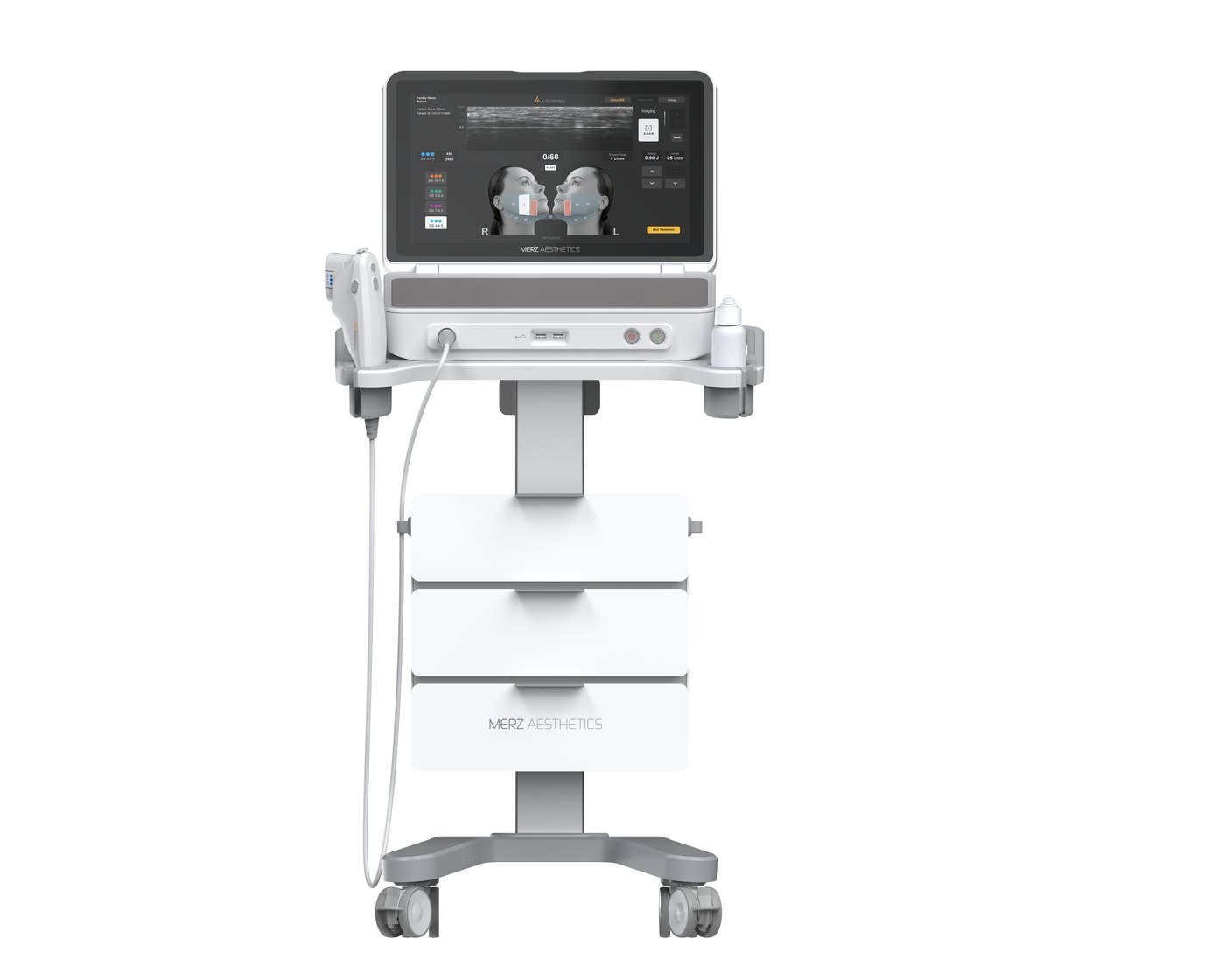
Of all the non-surgical lifting devices a Seoul clinic will offer you, Ultherapy is the one most likely to be mentioned by name before you even ask. It has been in the market since 2009, it has a large body of published work behind it, and it is expensive. It is also widely counterfeited, which makes it a useful device to understand properly.
Clinics in our partner network operate Ultherapy PRIME, the current-generation platform from Merz Aesthetics. Below is what the machine does, in plain terms.
The mechanism: heat delivered to a chosen depth
Ultherapy uses micro-focused ultrasound with visualisation, abbreviated MFU-V. Ultrasound waves are focused to converge at a single point below the skin surface, the same way a magnifying glass focuses sunlight. At that point the tissue reaches a temperature high enough to create a small, controlled coagulation point roughly the size of a grain of rice. The skin surface is not broken.
The body then repairs those points, and repair means new collagen. The visible change is not the treatment itself but the healing response to it, which is why the effect appears gradually over two to three months rather than on the day.
Three transducers cover three depths:
- 4.5 mm — reaches the superficial musculoaponeurotic system, the fibrous layer a surgeon tightens in a facelift.
- 3.0 mm — the deep dermis.
- 1.5 mm — the superficial dermis, used on thin skin and around the eyes.
What the “V” is for, and why it matters to you
The V in MFU-V stands for visualisation. The handpiece produces a live ultrasound image of the tissue underneath it — the same imaging principle used in obstetric scans — so the operator can see the layers before delivering energy. PRIME’s imaging system nearly doubles the field of view of the previous generation.
This is the single most practical feature of the device, for one reason: facial anatomy is not uniform. Skin and fat thickness vary between the cheek and the jawline, between a 32-year-old and a 58-year-old, and between two people of the same age. A 4.5 mm transducer fired into a thin area can deposit energy where it was not wanted. Being able to see the layer is what turns a fixed depth setting into a decision.
It is also the feature most often skipped. Imaging takes time, and time is the constraint in a busy clinic. When you are on the table, it is entirely reasonable to ask whether the operator is using the imaging screen and to ask to see it.
What it treats, and what it does not
Ultherapy PRIME holds FDA clearance for lifting the brow, the chin and the neck, improving lines on the décolleté, and firming skin on the abdomen, arms and knees.
What it addresses is laxity — skin and its underlying support layer losing tension. What it does not address is volume loss, pigmentation, surface texture or deep static folds. Those are different problems with different tools, and a device that is excellent for one is irrelevant to another.
It is also not a substitute for a facelift, and any consultation that presents it as one is overselling. The honest framing used in the literature is that it produces a measurable lift in appropriately selected patients, typically holding for around a year, after which maintenance is the question.
What a session is like
A full face and neck treatment usually runs 60 to 90 minutes. Energy delivery is felt as brief deep heat or a prickling sensation, strongest over bone — the jawline and brow. Discomfort varies a great deal between individuals, and clinics manage it with topical anaesthetic, oral analgesia or timing adjustments; discuss this before the session, not during it.
Downtime is minimal. Mild redness, swelling or tenderness to the touch is common for a few days. Less commonly, temporary numbness or small areas of nerve irritation occur. Ask the clinic directly what their protocol is if that happens.
The counterfeit question
This matters more than any specification. Because Ultherapy transducers are single-use consumables with a fixed shot count, there is a market in refilled and copied cartridges, and in machines that are not the branded device at all. A counterfeit transducer does not deliver the energy profile the treatment plan assumes.
Three checks, all of which a legitimate clinic will welcome:
- Ask to see the machine. The brand mark is on the unit. Photograph it if you want to.
- Ask to see the cartridge opened in front of you, and ask what the shot count is for your treatment. A quoted number of lines or shots is verifiable; “a full face” is not.
- Ask who is operating it. In Korea, energy-device treatment is performed under a physician’s responsibility. Ask whether a doctor is performing or supervising your session, and get a straight answer.
None of these questions are rude. They are the questions the manufacturer itself encourages patients to ask, and a clinic that has invested in genuine equipment has every reason to show you.
The short version
Ultherapy PRIME is a laxity tool that heats a chosen tissue depth to trigger collagen repair, and its distinguishing feature is that the operator can see the layer first. It suits mild to moderate sagging in someone who does not want surgery, works gradually, and needs a real consultation to decide whether laxity is actually your problem. Verify the device and the cartridge. Then judge the plan.
The Seoul Glow is a registered foreign-patient facilitator. We coordinate care; all treatment is performed by independent licensed clinics. Nothing here is medical advice — decisions about a procedure belong between you and a qualified doctor.